About Me
I’ve always been interested in cultural and social differences and similarities, and even at the age of 18, I was already thinking about how to explore and present all of this through film. Looking back, I see my first documentary film, Kultúrkép (“Cultural Landscape”), as the first step toward what I do today. Kultúrkép (“Cultural Landscape”) was my 12th-grade project at the Pesthidegkút Waldorf School, in which I discussed topics falling within the broadly defined concept of culture with 15- and 16-year-old American and Hungarian Waldorf students. This film won the grand prize for student films at the Dialketus Festival in 2004.
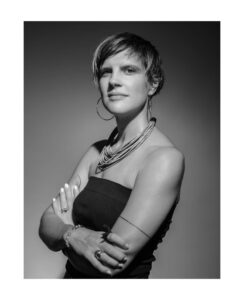
In 2007, I earned my BA in Media Production from the University of Bedfordshire in England; I lived in London for a total of four years. After moving back home, I studied at the University of Theater and Film Arts, where I graduated in 2015 with a master’s degree in documentary film directing. My thesis film, Szebenézés (“Confrontation”), won the Grand Prize in the ZOOM-IN section of the Verzió International Documentary Film Festival. My first feature-length documentary, Anyáim története (“The Story of My Mothers”) (co-directed with Asia Dér), was completed in the spring of 2020 and premiered at the Hot Docs Festival in Canada. I am currently working on my second feature-length film, Szia Sári! (“Hi, Sári!”), which explores our own family dynamics.
Since 2015, in addition to directing, I have been working as an active participatory film facilitator, regularly holding film workshops and camps throughout Hungary, primarily for children. In my workshops, I work with both disadvantaged and non-disadvantaged children in parallel and mixed groups. Since 2018, I have been a student at the SZFE Doctoral School; my research topic is: “The Camera as a Catalyst for Intra- and Intergroup Cohesion,” which examines how the filmmaking process and the use of the camera influence the images we form of one another, how it resolves (or is affected by) intergroup stereotypes, and how it affects intra-group conflicts.
“Although participatory video has been a widespread method in many parts of the world since the 1960s, in Hungary the concept of participation has, until now, generally not been explored through cinematic means. As a member of the Minor Media Research Group, my research maps contemporary participatory filmmaking practices in Hungary; to analyze and develop a methodology applicable in Hungary, I supplement existing analyses with my own examples. For the second year, we have been holding so-called “Catalyst” workshops with the Zöld Pók Media Workshop, in which teenagers from Budapest and Hernádszentandrás, as well as those from Budapest and Szomolya, meet and connect through filmmaking. Embedding my research within the OTKA participatory film research project offers an opportunity to place the specific Hungarian situation within an international context and to use participation as a tool to reduce social disparities.” In September 2019, Sári participated in the InsightShare course, where participants were introduced to the PV MSC impact analysis technique. The technique combines participatory video and the “most significant change” methods. Participants share the changes that were most significant to them during the group work process, and from among the many important changes, the most significant one is selected (through a participatory selection process). To conclude the PVMSC evaluation, participants film the story of the most significant change they selected (using interviews, role-playing, drawings, and photographs), thereby making it accessible to others. The method offers numerous benefits for both researchers and participants: it can reveal barriers to the program’s success, encourage constructive dialogue and mutual understanding, and allow participants to collectively interpret why and how change did or did not occur.